

Why the Spec Sheet Alone Will Mislead You at This Budget
The RTX 4060 That Performs Like an RTX 3060: What TGP Means
Two laptops. Same GPU model number on the box. Price difference of $200. When you benchmark them, one delivers 30 percent better sustained frame rates than the other. The reason is Total Graphics Power (TGP): the wattage the manufacturer allocates to the GPU. A higher TGP means more processing power available to the chip. An RTX 4060 at 115 watts performs very differently from an RTX 4060 at 80 watts, and both are marketed using the same model name.
At $1,500, you can buy a genuinely capable machine or something that looks like one on paper. TGP is the first specification that separates the two.
The Two Most Common Specification Mistakes at the $1,500 Price Point
The first mistake is choosing a laptop with an impressive GPU paired with 8GB of single-channel RAM. The memory bottleneck limits the output regardless of GPU quality. The second is buying with a 60Hz display. If the GPU can produce 120fps but the screen only shows 60, you are paying for capability you cannot see or feel. Both mistakes are invisible in a standard spec comparison table. Both are avoidable once you know what to check.
What $1,500 Realistically Buys in Singapore’s 2026 Gaming Laptop Market
The GPU Tier Available at This Budget: What to Expect from RTX 4060 and RTX 4070 Laptop
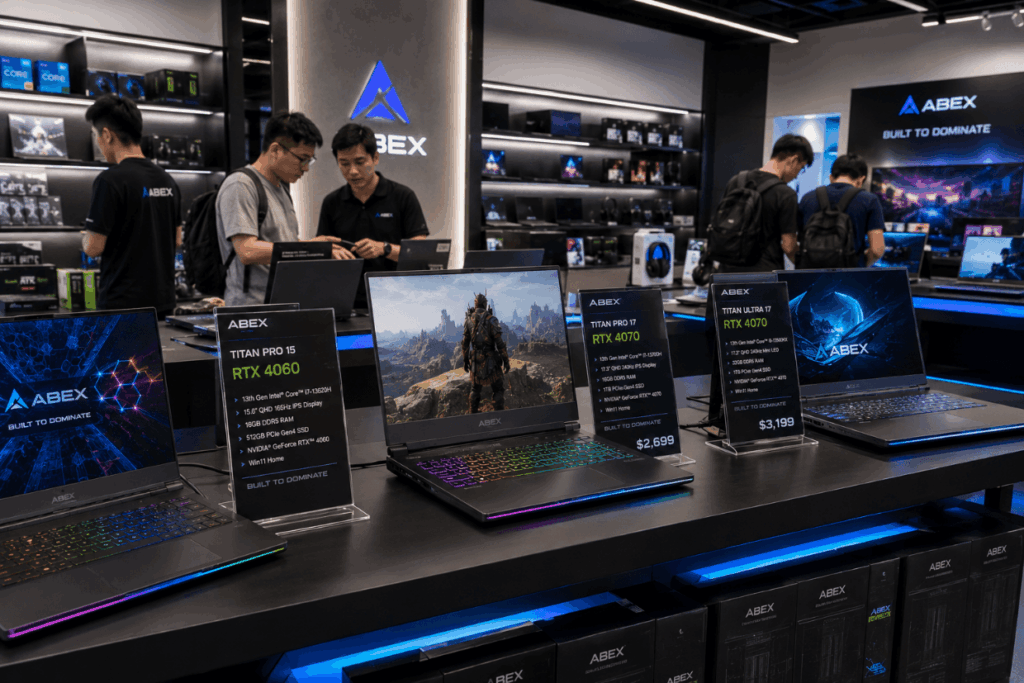
At $1,500 in Singapore’s 2026 market, the RTX 4060 laptop is the mainstream entry point. A well-configured RTX 4060 at 115W TGP handles 1080p at high to ultra settings across most current AAA titles. The RTX 4070 laptop appears at the upper end of this budget, but fitting it within $1,500 typically requires trade-offs in other specifications that need careful evaluation.
The CPU Generation That Pairs With This Budget: Intel Core Ultra vs AMD Ryzen 7000 and 8000 Series
Intel Core Ultra 5 and Core Ultra 7, alongside AMD Ryzen 7 from the 7000 and 8000 series, are the mainstream CPU options at this price in 2026. For gaming specifically, the GPU is the primary driver. Do not sacrifice GPU tier or TGP for a higher CPU model number.
What $1,500 Cannot Buy: Being Honest About the Category’s Limits
This budget does not deliver RTX 4080 or 4090 GPU performance, or premium thin-and-light build quality alongside full output. It also does not offer excellent battery life, or OLED at high refresh rates without trade-offs elsewhere. For the most demanding 2026 AAA titles at maximum settings above 1440p with consistent high frame rates, $1,500 is insufficient. For competitive multiplayer, most current AAA titles at 1080p, and any player prioritising frame rate over maximum visual fidelity, it is more than adequate.
The Six Criteria That Determine Whether a $1,500 Gaming Laptop Is Worth Buying
Criterion 1: GPU TGP – How Much Power the Card Actually Gets
What TGP Means and Why the Same GPU Card Performs Differently in Different Laptops
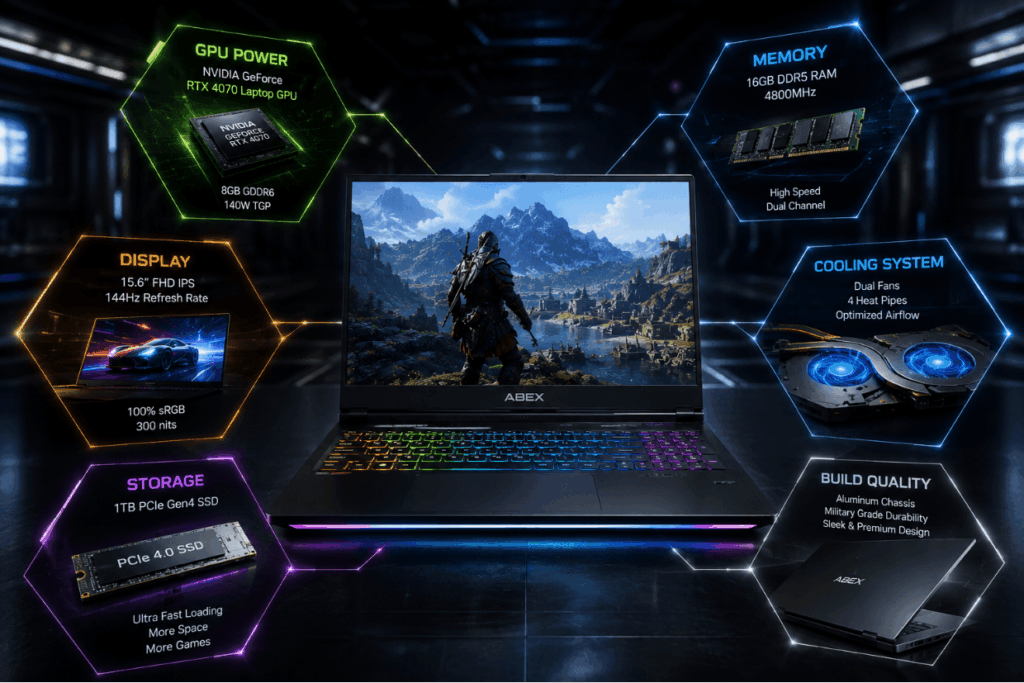
TGP is the maximum sustained power the manufacturer allows the GPU to consume. Higher TGP means more processing power available to the chip. A laptop that constrains the GPU to 80 watts is throttling its own hardware to reduce heat or extend battery life at the expense of frame rates.
The Minimum TGP to Look For at $1,500 in Singapore
For an RTX 4060 laptop at $1,500, look for a base TGP of at least 100 watts. Ideally 115 watts. Dynamic Boost can push this higher during brief peaks, but sustained TGP determines extended session output. Find it in the GPU specification line, or verify it in an independent hardware review from Notebookcheck.
Criterion 2: RAM – Amount and Configuration
Why 8GB Is No Longer Sufficient for Modern Gaming in 2026
Current AAA titles regularly consume 8 to 12GB of RAM during play. An 8GB system leaves no headroom for the operating system and background processes, resulting in stuttering, slow texture loading, and degraded output during extended sessions. A laptop at $1,500 shipping with 8GB will need a RAM upgrade within the first year.
Why Single-Channel vs Dual-Channel RAM Affects Gaming More Than Most Buyers Expect
Single-channel RAM uses one memory bus. Dual-channel uses two, roughly doubling memory bandwidth. Benchmarks consistently show 5 to 15 percent frame rate differences between 16GB single-channel and 16GB dual-channel in the same laptop. The GPU’s ability to receive and process data depends partly on how quickly the memory subsystem can supply it.
What to Look For: 16GB Dual-Channel as the Minimum Acceptable Configuration
The specification should say 2x8GB or explicitly confirm dual-channel. “16GB upgradeable” is not the same as shipping in dual-channel. Confirm before purchasing.
Criterion 3: Display – Refresh Rate, Panel Type, and Resolution
Why 60Hz Is a Dealbreaker in a $1,500 Gaming Laptop
A 60Hz display shows 60 frames per second regardless of how many frames the GPU produces. If the GPU delivers 120fps, you experience 60fps. The capability is wasted. A 60Hz display in a laptop at this price in 2026 is a configuration that is not optimised for gaming.
144Hz vs 165Hz vs 240Hz: What the Difference Means for the Games You Play
144Hz is the functional minimum for a genuine experience at this budget. 165Hz adds minimal real-world benefit over 144Hz. 240Hz matters meaningfully for competitive multiplayer players in fast-paced games where consistently high frame rates are achievable and perceptible.
IPS vs TN vs VA vs OLED at This Budget: Which Panel Types Are Worth Having
IPS provides viewing angles, colour accuracy, and image quality for both gaming and general use. TN panels prioritise response time at the expense of colour and viewing angles, and are an outdated compromise at this price. OLED at $1,500 is rare and typically requires trade-offs in cooling or GPU tier to accommodate the cost.
Criterion 4: Cooling Design and Sustained Performance
What “Sustained Performance” Means and Why It Matters More Than Boost Clock Speed
Peak boost is what a laptop achieves during the first 30 to 60 seconds of load. Sustained output is what it delivers after 15 and 30 minutes of continuous play. Your session does not last 30 seconds. Sustained numbers are the only figures that reflect your actual experience.
How to Assess a Gaming Laptop’s Cooling Design Without Opening the Chassis
Chassis thickness is the clearest external indicator. Laptops that sustain RTX 4060 output at 115W typically sit between 20 and 24mm thick and weigh 2.1 to 2.6 kilograms. Vapour chamber cooling in the specifications indicates investment in thermal management. Fan noise is a proxy: a laptop that runs loud under sustained load is prioritising output; one that runs quietly is likely throttling.
Red Flags That Suggest a Laptop Will Throttle Under Gaming Load
Three red flags appear in independent reviews. First: GPU TGP drops below base specification after 10 minutes of sustained load. Second: CPU clock speeds fall significantly during combined CPU and GPU stress. Third: thermal throttling notifications appear in hardware monitoring software during extended play.
Criterion 5: Storage Speed and Capacity
Why NVMe PCIe Gen 4 Matters for Gaming Load Times in 2026
PCIe Gen 4 NVMe delivers sequential read speeds of 5,000 to 7,000 MB/s. Gen 3 tops out around 3,500 MB/s. The practical result is faster level loads, reduced texture streaming stutters in open-world titles, and faster installation. When a spec sheet says “NVMe SSD” without specifying generation, assume Gen 3 until confirmed otherwise.
Why 512GB Is Not Enough for a Gaming Laptop’s Primary Drive
Current AAA titles regularly require 80 to 150GB each. A 512GB drive fills with three to five games before accounting for the operating system and applications. The minimum worth targeting at $1,500 is 1TB NVMe. External storage or a secondary drive will be necessary regardless, but starting at 512GB means you are in that situation immediately.
Criterion 6: Build Quality, Weight, and Portability Trade-offs
What “Gaming Laptop Build Quality” Means at $1,500
Most machines at this price use reinforced plastic chassis with aluminium lids appearing at the upper range. A well-built plastic chassis laptop outperforms an aluminium ultrabook in every relevant metric. Check hinge flex when lifting the lid with one hand and keyboard flex under firm typing pressure.
The Weight and Thickness Trade-off That Most Gaming Buyers Underestimate
RTX 4060 output at high TGP requires thermal infrastructure. That infrastructure adds weight and thickness. At $1,500, you can have strong output or genuine portability. Expecting both means accepting cooling compromises that reduce what you paid for.
What Your Game Library Tells You About Which $1,500 Laptop to Choose
| Game Type | First Priority | Second Priority | Target Specification |
| Competitive multiplayer (Valorant, CS2, Apex) | Display refresh rate | GPU TGP | 240Hz display, RTX 4060 at 115W+ |
| AAA single-player | GPU TGP and sustained cooling | Display quality | RTX 4060 at 115W+, 1080p IPS at 144Hz |
| Creative work combined with gaming | RAM and CPU capability | Display colour accuracy | 16GB or 32GB dual-channel, colour-accurate panel |
Competitive Multiplayer (Valorant, CS2, Apex Legends): Why Refresh Rate Matters Most
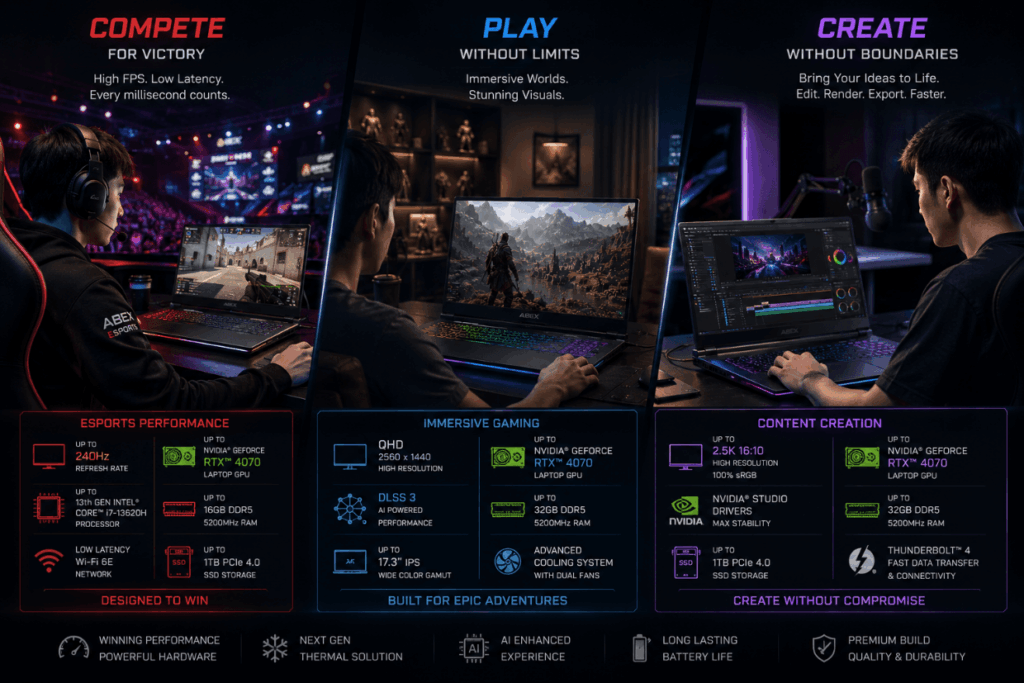
These titles run at very high frame rates on mid-range hardware. The display refresh rate is the genuine ceiling. For competitive multiplayer players, an RTX 4060 at 115W with a 240Hz display delivers a better moment-to-moment experience than an RTX 4070 at 80W with a 144Hz display. The stronger GPU produces more frames, but the display determines how many you can see and act on.
AAA Single-Player Titles: Why GPU TGP and Cooling Define the Experience
For extended single-player sessions, sustained GPU output under two to three hours of continuous load determines the actual experience. A 1080p IPS display at 144Hz is excellent for this game type. GPU TGP and cooling design should lead the decision.
Creative Work Combined With Gaming: What Changes in the Specification Priority
Adding video editing or rendering to daily use shifts the priorities. RAM becomes more important: 32GB is worth targeting. Display colour accuracy matters for creative output. CPU capability warrants more weight because creative workloads are processor-intensive in ways that most gaming titles are not.
How to Verify Any Gaming Laptop’s Real-World Performance Before Buying
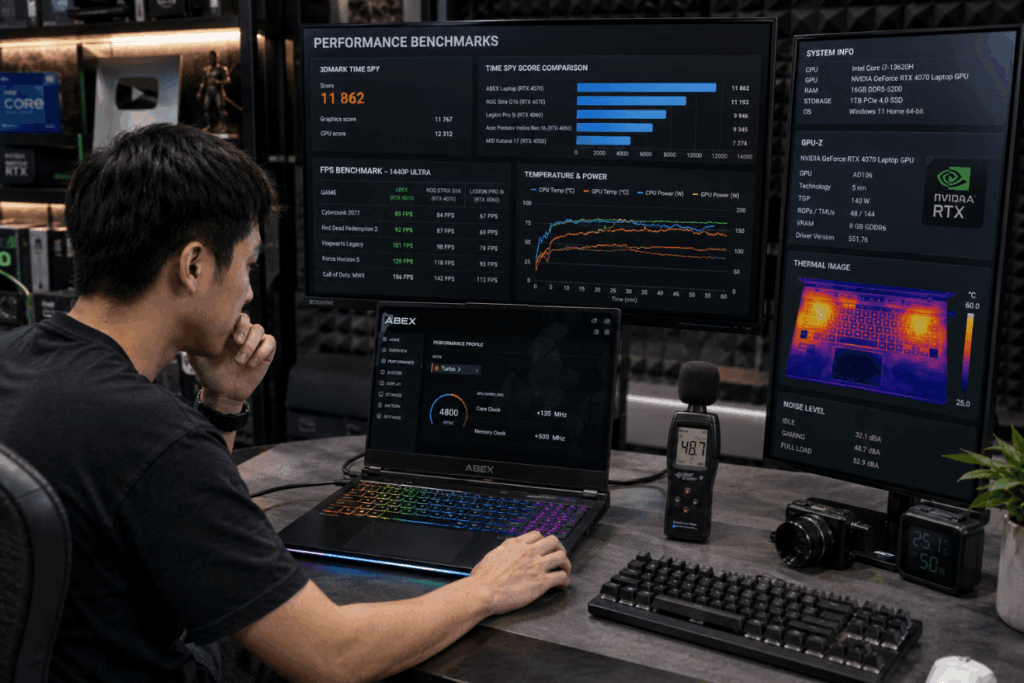
The Benchmarks Worth Checking: What to Look Up and What to Ignore
Check 3DMark Time Spy for GPU comparison and Cinebench R23 multi-core sustained score for CPU capability. In reviews specifically, look for benchmarks measured at 15 and 30 minutes of continuous load, not just the opening sprint. Ignore manufacturer benchmark claims without context, peak boost scores without sustained data, and benchmark results from review units using manufacturer-optimised firmware.
Where to Find Sustained Performance Data That Marketing Does Not Provide
Independent hardware review sites that test sustained load over extended sessions provide the thermal data that spec sheets omit. Read the thermal section and conclusion of any review before the benchmark charts. A laptop that scores well on charts but throttles during extended play delivers a different experience than the numbers suggest.
How Abex Laptop Singapore’s Gaming Category Represents This Tier in Singapore’s Market
Abex Laptop Singapore is a Singapore-based laptop retailer whose sub-$1,500 gaming category includes models that can be compared against the six-criteria framework above, with in-store assessment available before purchase commitment.
Conclusion
At $1,500 in Singapore’s 2026 market, the GPU model name on the box is only one input in a purchasing decision. TGP, RAM configuration, display refresh rate, sustained cooling, storage generation and capacity, and chassis thermal design are equally important and more consistently overlooked. A well-configured RTX 4060 laptop at 115W TGP, with 16GB dual-channel RAM, a 144Hz or higher IPS display, 1TB NVMe Gen 4 storage, and a chassis built to sustain that output over a two-hour session is a capable 1080p machine for any current title. Checking sustained data from independent hardware reviews before committing to a purchase is the single most valuable step any buyer can take at this budget.